
Assipattle and the Stoor Worm
Orcadian folktale of a hero who slays a giant sea serpent.

Assipattle and the Stoor Worm is an Orcadian folktale about the fight between its title hero and a massive sea serpent called the stoor worm. The story was recorded by 19th-century antiquarian Walter Traill Dennison, and later retold by fellow Orcadian folklorist Ernest Marwick in a 20th-century version that combines Dennison’s writings with details from other oral storytellers.
Assipattle, the seventh son of a farmer, lives with his family on their farm in a valley beneath the hillsides of Leegarth. He is a lazy daydreamer, scorned by his older brothers and parents, though his sister—to whom he is deeply attached—is more tolerant of his idle ways. Often neglected and dressed in his brothers’ tattered hand-me-downs, he spends his days doing menial tasks but avoids work whenever possible. His brothers frequently tease him, and in the evenings he sprawls among the ashes by the fire, telling stories in which he is always the victorious hero.
Assipattle’s loneliness grows when his sister leaves home to work as a maid for Princess Gem-de-lovely, the king’s only daughter and sole heir. Soon after, the kingdom falls into turmoil when the evil stoor worm arrives. This gigantic, vile sea serpent can destroy entire villages. A sorcerer advises the king that the only way to appease the monster is to feed it seven virgins every Saturday. Outraged that their daughters are being eaten, the citizens demand another solution. The king is then told the only way to make the monster leave is to sacrifice the princess, though he is given time to find someone to slay it first. One noble insists that if the princess is sacrificed and the serpent remains, the sorcerer should be the next victim, and the court agrees.
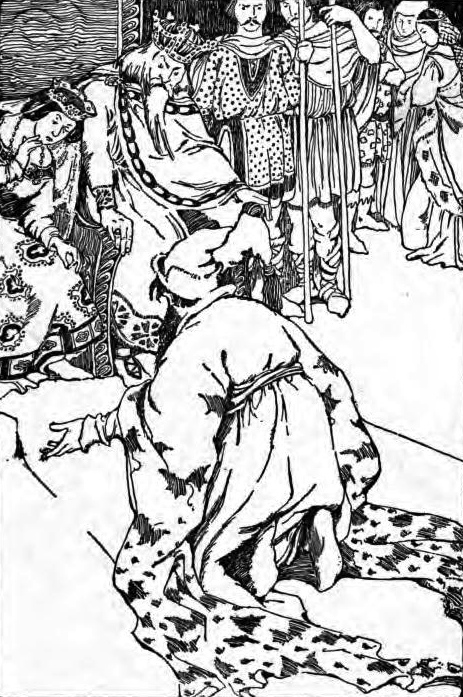
Desperate to save Princess Gem-de-lovely—loved by all except her evil stepmother—the king sends messengers to announce that he will give his kingdom, the magical sword Sickersnapper, and the princess’s hand in marriage to anyone who defeats the stoor worm. A messenger reaches Leegarth and delivers the news; Assipattle declares he will trounce the beast, drawing mockery from his father and brothers.
Many would-be heroes arrive but shy away upon seeing the monster. On the night before the princess is to be offered to the stoor worm, the despondent king orders a servant to ready a boat, intending to fight the monster himself with the magic sword.
- field
- Folklore
- origin
- Orkney
- known_for
- Dragon-slayer tale with local aetiologies
- preserved_by
- Walter Traill Dennison (19th century), Ernest Marwick (20th century)
- classification
- Märchen, dragon tale, Hesione tale
Lore & Background
The story follows Assipattle, the seventh son of a goodman, who lives on his father's farm in a valley under the hillsides of Leegarth. A lazy daydreamer, he is scorned by his older brothers and parents but is tolerated by his sister. When the evil stoor worm—a gigantic vile sea serpent capable of destroying entire villages—arrives in the kingdom, the king is advised by a sorcerer to feed it seven virgins each Saturday. The citizens' outrage forces the king to seek another solution, and he is told the only way to make the monster leave is to sacrifice his daughter, Princess Gem-de-lovely. The king offers his kingdom, the magical sword Sickersnapper, and the princess's hand in marriage to anyone who can defeat the stoor worm.
Reader's Guide
Assipattle and the Stoor Worm is significant as a preserved Orcadian folktale that blends dragon-slayer motifs with local geography, explaining the formation of the Orkney, Shetland, and Faroe islands, the Baltic Sea, and Iceland. Folklorist Jacqueline Simpson classifies it as a dragon-slayer tale, describing it as 'almost pure märchen in style and content, apart from the local aetiologies.' E. S. Hartland called it 'a purely Norse tale,' demonstrating the triumph of bravery over adversity. The tale is also noted as the male counterpart of Cinderella stories, possibly indicative of eras when inheritance was via daughters. The name Assipattle translates as 'Ash-paddle' or 'a person who rakes through the ashes,' linking it to the Ash-Lad figure in Norwegian folk stories. The tale's legacy endures through the work of Dennison and Marwick, who preserved it from oral tradition.
Did You Know?
- The name Assipattle translates as 'Ash-paddle,' similar to Askeladd (Ash-Lad) in Norwegian folk stories.
- The magic sword Sickersnapper is defined by Walter Traill Dennison as likely meaning 'severe biter.'
- The tale includes aetiologies: the stoor worm's teeth became the islands of Orkney, Shetland, and the Faroes; its tongue created the Baltic Sea; its body became Iceland.
- Sir George Dasent gave a version of the story where Assipattle was named Boots, which caused exasperation among Orcadians.
The Beast of Orcadian Waters
The stoor worm occupies a fearsome place in Orcadian folklore as a colossal sea serpent born from malevolent spirits. Its physical description in the surviving accounts is staggering: a head the size of a great mountain, eyes compared to deep dark lochs or, in some tellings, a single blazing orb, and a body whose length stretches beyond any measurable distance across the ocean. The creature's forked tongue functions almost like a pair of tongs, capable of crushing ships and houses and hauling entire hillsides into the sea. Its most lethal weapon, however, is its breath—a putrid blast that withers vegetation and kills any animal or human it touches. Giant swells and earthquakes were attributed to the beast yawning, a sign it hungered rather than merely tired. Islanders regarded it as the worst of nine great curses afflicting humanity. A separate account even mentions a lesser stoor worm, its offspring, which meets its end when an oversized mythical ship cleaves it in two. The creature has also been characterized simply as a sea dragon, anchoring it firmly in the broader Germanic tradition of monstrous serpents.
The Sacrifice and the King's Dilemma
When the stoor worm's approach threatened a coastal kingdom, the ruler turned to a wise man for counsel. The spaeman's grim recommendation was to appease the beast with a weekly offering of seven virgins. The arrangement took hold: every Saturday, young women were bound and set upon the shore, where the serpent would rear from the waves and sweep them into its gaping mouth. For a time the practice held, but the islanders grew desperate as the pool of eligible girls dwindled. They pressed the king for a solution, and the spaeman, with evident reluctance, proposed that the monarch's own daughter—Princess Gem-de-lovely, his most treasured possession—be the final sacrifice. A ten-week grace period was granted before the princess was to be delivered. During that window, messengers were dispatched to every corner of the realm with a sweeping proclamation: whoever could slay the monster would inherit the kingdom, the princess's hand, and a magic sword the king had received from the god Odin. Between thirty and thirty-six prospective heroes answered the call, yet every single one turned back without ever facing the creature.
Assipattle's Descent
On the morning before the princess was to be sacrificed, Assipattle—the youngest son of a local farmer, despised by his own household—mounted his father's horse and rode to the beach at dawn. The stoor worm was just stirring from its slumber. Assipattle seized some hot peat and a small boat, and the waves carried him directly into the creature's yawning mouth. The boat tumbled down through the beast's throat and came to rest in the depths of its stomach. There, in the darkness, he drove the still-burning peat into the stoor worm's liver, igniting a fire that blazed like a furnace. The agony of the burning organ triggered a violent fit of retching that hurled Assipattle, who had scrambled back into his boat, out of the monster's mouth and onto the shore. The creature's writhing death throes sent columns of smoke from its mouth and nostrils, blackening the sky. The islanders, convinced the world was ending, climbed a hillside to watch from a distance as tidal waves surged below. As the beast perished, its teeth scattered to form the islands of Orkney, Shetland, and the Faroes, while its vast body became Iceland.
Roots in Norse Myth and Language
The stoor worm is widely regarded as an Orkney variant of Jörmungandr, the Midgard Serpent of Norse mythology, and the name itself carries deep linguistic roots. The Old Norse Storðar-gandr, an alternative designation for the world serpent, is a likely ancestor of the term. In Scots usage from the late fourteenth century onward, stoor or stour described fierce fighting and violent weather conflicts; later dictionaries extended the meaning to substantial, large, and big, possibly linking it to the Old Norse stórr. Mester, meaning master, suggests the creature was conceived as the supreme patriarch of all such monsters. The word worm, in its older Saxon and Norse forms including the Old English wyrm, simply denoted a dragon or serpent. Scholars have also drawn parallels between Assipattle's exploit and Herakles' destruction of a sea monster to rescue Hesione. It has been proposed that tales of this dragon-slayer genre crystallized during a period of cultural enlightenment, when the practice of offering human sacrifices to bestial divinities was gradually being suppressed.
Gallery
Frequently Asked Questions
What is Assipattle and the Stoor Worm?
It is an Orcadian folktale in which a young farmer slays a colossal sea serpent that is devastating the local community. The narrative was first transcribed by 19th-century antiquarian Walter Traill Dennison and later reshaped by fellow Orkney folklorist Ernest Marwick, who wove in details from other oral tellers.
Who is Assipattle?
Assipattle is the seventh son of a farmer dwelling in a valley below the Leegarth hillsides in Orkney. He is portrayed as a lazy, brooding daydreamer who is mocked by his older brothers and parents, yet he ultimately steps forward as the community's saviour.
What is the Stoor Worm in the tale?
The Stoor Worm is an enormous, destructive sea serpent that plagues the coastal settlement and holds Assipattle's sister captive. It functions as the central antagonist the hero must defeat to free his people and his family.
How does the Assipattle and Stoor Worm story end?
Assipattle kills the serpent and rescues his sister, who had been imprisoned by the creature. The tale closes with the community's deliverance and Assipattle's transformation from a scorned idler into a celebrated hero.
Why is Assipattle and the Stoor Worm important to Scottish folklore?
Scholars classify it as a Märchen, a dragon-slaying tale, and a Hesione-type rescue story, making it a rich composite of several folk-narrative traditions. It also embeds local aetiologies—folk explanations for Orkney's landscape features—giving it particular value as a window into Orcadian oral culture.
More in Scottish folklore 1-24
Spotted an error? Know more?
This is a living reference — every entry is fact-audited, and reader corrections feed straight into our audit queue. Suggest an edit · See this site's audit record